

1. Definition – Safety Management
Safety Management aims to identify hazards to aviation safety at an early stage and to minimise or eliminate the associated risks—before incidents or accidents occur.
It enables an organisation to manage its activities in a systematic, structured, and risk-based manner.
A clear understanding of the organisation’s role within the safety context helps to:
- Prioritise safety risks effectively
- Allocate resources efficiently
- Achieve sustainable safety outcomes
Safety management is an organisation-wide responsibility. It applies across the entire organisation—particularly where multiple aviation approvals or organisations are combined under one structure.
The Safety Management System (SMS) is based on the following core elements:
- Safety Policy and Safety Objectives
- Establishing a clear safety policy and safety objectives
- Commitment and accountability of senior management
- Safety responsibilities at management level
- Appointment of key responsible persons
- Coordination of emergency planning
- SMS documentation – integrated into the QMS or as a standalone SMS manual
- Safety Risk Management
- Hazard identification
- Risk analysis and assessment
- Development and implementation of risk mitigation measures
- Ensuring safety
- Safety performance measurement and monitoring (Compliance Monitoring)
- Management of change
- Continuous improvement of the SMS
- Promotion of safety
- Training and education (e.g. Human Factors, error management, procedures)
- Safety communication within the organisation
The requirements for a Safety Management System vary slightly depending on the area of application:
- Initial Airworthiness: according to (EU) 748/2012, Part 21, Subparts G and J
- Continuing Airworthiness: according to (EU) 1321/2014, Part-CAMO and Part 145
2. Implementation of an Integrated Management System (IMS)
Quality Management Systems (QMS) established in accordance with EASA Part 21, EASA Part 145, or EASA Part-CAMO can generally be aligned with and integrated into the requirements of a Safety Management System (SMS).
An Integrated Management System (IMS) combines both approaches within a unified structure, thereby enhancing transparency, efficiency, and clear allocation of responsibilities within the organisation.
The following overview illustrates the respective focus areas of QMS and SMS and highlights their compatibility as well as the complementary nature of both management approaches.
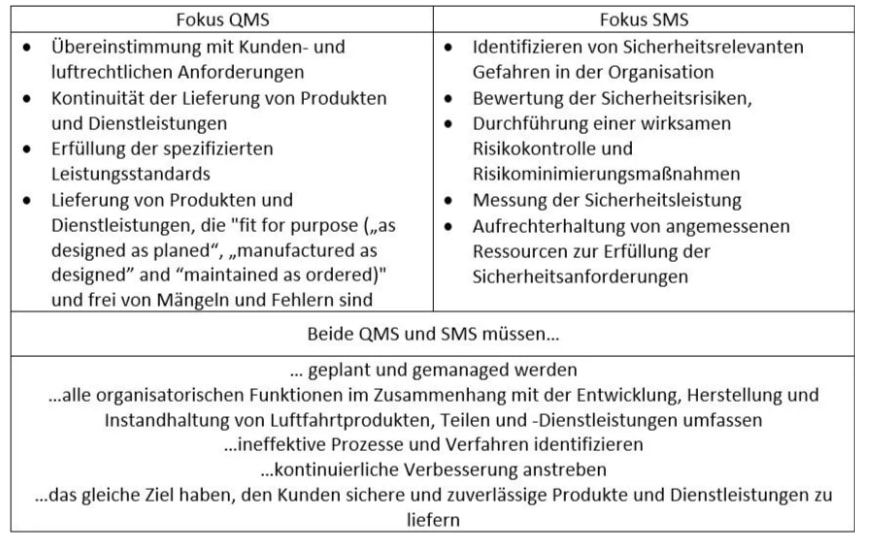
For organisations holding multiple aviation approvals, an integrated, cross-functional Safety Management System is highly beneficial. It establishes a unified structure and prevents redundant or conflicting safety management processes.
3. ACC Services in the Area of Safety Management (SMS)
Our Safety Management (SMS) services include, among others:
- Conducting a gap analysis to identify deviations between your existing management system and SMS requirements in accordance with EASA Part 21, Part 145, and Part-CAMO (including AMC and GM)
- Development of a structured implementation strategy for the sustainable integration of SMS requirements within your organisation
- Preparation of new manuals and procedures, as well as targeted adaptation of existing documentation based on the gap analysis
- Training and education of your personnel to support the successful introduction, application, and continuous development of the Safety Management System