

Foundation for the Development and Certification of Aviation Products
1. When is a DOA Required?
Any organisation intending to develop aviation products such as aircraft, engines, or propellers, or to implement changes to existing type designs, generally requires – depending on scope, responsibilities, and requested privileges – an approval as a Design Organisation in accordance with (EU) 748/2012, Part 21, Subpart J, known as the Design Organisation Approval (DOA).
This also applies to the development of parts and appliances – such as structural components, landing gear, avionics, or ETSO articles – in accordance with the applicable Certification Specifications (CS).
For organisations with a clearly defined and limited scope of development, alternative procedures in accordance with 21.A.14 (Alternative Procedures to DOA – ADOA) may apply.
2. Demonstration of Certification Compliance
2.1 Requirements and Formal Demonstration of Compliance
The applicant – whether a legal entity or a natural person – must demonstrate compliance with all applicable certification specifications. These include in particular:
- Design standards of the respective aircraft category
- Environmental requirements
- Operational suitability data
- Special Conditions, where applicable
Compliance must be demonstrated in accordance with EASA Part 21, Subpart J, as well as other relevant subparts (including A, B, D, E, K, P, and Q), and based on the organisation’s approved procedures.
Upon successful completion, and depending on the scope of approval, the following declarations may be issued:
- Declaration of Compliance (DoC)
- Declaration of Design and Performance (DDP) – exclusively for ETSO articles
Compliance must be demonstrated within the Design Management System (DMS).
2.2 Systemic Prerequisites for Approval Eligibility
To demonstrate an organisation’s capability to obtain approval for a specific design, clear organisational and procedural prerequisites must be established and documented.
Principle: The more complex or innovative a product or change, the higher the requirements placed on the Design Management System (DMS).
The following prerequisites may be fulfilled to demonstrate an organisation’s capability for the intended approval of a specific design:
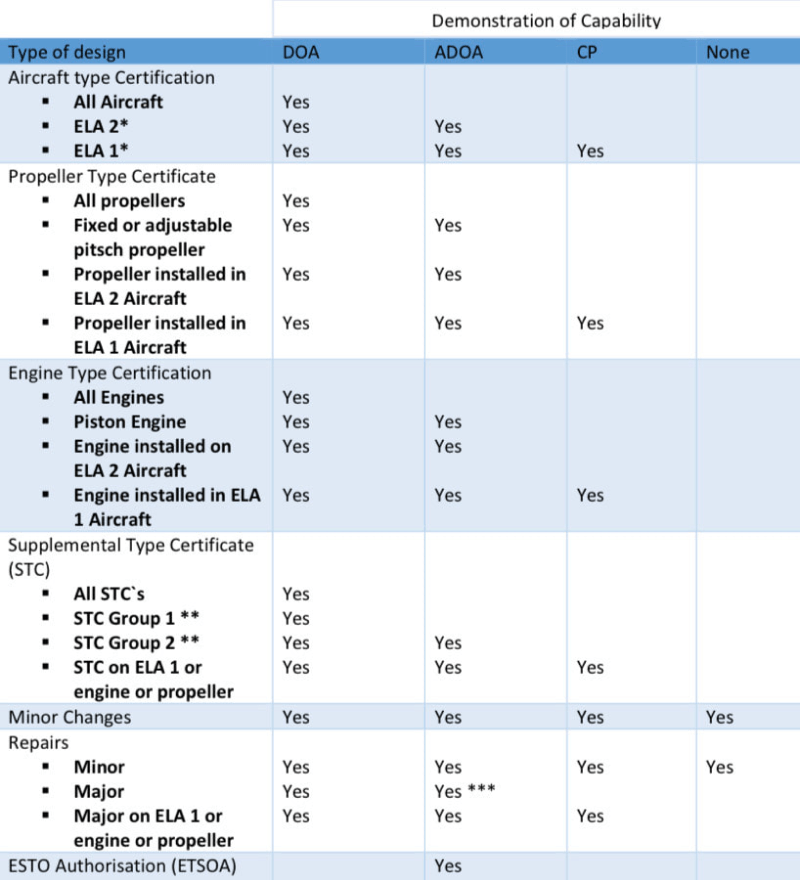
* For definitions see (EU) 748/2012 Article 1
** For definitions see GM 21.A.112B
*** Upon Agency agreement Quelle: EASA
3. The Design Management System (DMS)
The Design Management System (DMS)—referred to in regulatory terms as the Design Assurance System in accordance with 21.A.239 and 21.A.243—is the central control and oversight system for designs and design changes within the scope of a DOA.
It provides the foundation for:
- Managing development projects
- Ensuring compliance with certification requirements
- Oversight of external design subcontractors
- Maintaining airworthiness within the organisation’s scope of responsibility
3.1 Integration of the Safety Management System (SMS)
The Safety Management System (SMS) is an integral part of the DMS.
Its purpose is to:
- Identify hazards related to the product, product changes, or the design organisation at an early stage
- Systematically assess safety-related risks
- Define appropriate mitigation measures and continuously monitor their effectiveness
This ensures that safety-relevant aspects are managed proactively and in a structured manner.
3.2 Core Elements of System Integrity
An effective DMS is based on two independent control mechanisms, which are defined in the organisation’s approved procedures and subject to regulatory oversight:
a. Design Control (Product-related)
Independent design verification by a Compliance Verification Engineer (CVE) in accordance with the four-eyes principle. This ensures the technical integrity of individual designs.
b. System Monitoring (Organisation-related)
Implementation of an Independent System Monitoring (ISM) function for the continuous evaluation of system effectiveness. This ensures organisational integrity and sustained approval capability.

4. Organisational Requirements for DOA
To establish a design organisation in accordance with EASA Part 21, Subpart J, the following prerequisites must be met:
- Establishment of appropriate technical, organisational, and personnel structures
- Preparation of a Design Organisation Handbook (DOH) describing the Design Management System (DMS)
- Consideration of the relevant Part 21 sections (J, A, B, D, E, K, P, Q)
- Preparation of a Flight Test Operations Manual (FTOM), if flight testing is conducted
Approval as a Design Organisation (DOA) is only possible if these elements are implemented and documented in a structured manner.
5. Our DOA Consulting under Part 21
We support you in establishing or optimising your design organisation in accordance with EASA Part 21, Subpart J—through to successful approval as a Design Organisation.
Our service portfolio includes, among other things:
- Development and tailored adaptation of your Design Organisation Handbook (DOH) – aligned with your organisation and specific development activities
- Preparation or optimisation of a Flight Test Operations Manual (FTOM)
- Training and coaching of your personnel on relevant processes, regulatory requirements, and standards
- Gap analysis of your existing system against Part 21 requirements (in particular J, A, B, D, E, K, P, Q)
- Conducting internal audits and pre-approval audits prior to the official EASA audit (Phase 3)
- Interim management for the Independent System Monitoring (ISM) function
- Preparation, support, and follow-up of EASA audits and technical meetings
- Our objective is to deliver a structured, audit-ready, and practical DOA solution – regulatory robust and efficiently implemented.