

1. Product Certification and Product Changes
Aircraft, engines, propellers, as well as their parts and appliances, are subject to applicable aviation certification requirements. The scope of certification depends on the respective aircraft category, as well as the type and extent of the product or the intended modification.
Following successful certification, the competent authority—within the European Union, EASA—issues the design approval. This may take, for example, the following forms:
- Type Certificate (TC)
- Supplemental Type Certificate (STC)
- Approval of major or minor changes
- Approval of repairs
In certain cases, approved design organisations (DOA) may issue such approvals themselves within the scope of their granted privileges.
Certification of parts and appliances
The certification of parts and appliances is generally conducted within the framework of product certification and forms part of the respective type certificate or corresponding changes to the type certificate of the overall product.
An exception applies to equipment that is certified independently in accordance with CS-ETSO and EASA Part 21, Subpart O.
Organisational prerequisites
To perform product certification or implement a change to an existing certification, the organisational requirements in accordance with EASA Part 21 must be fulfilled.
Depending on the product category, certification can be achieved by demonstrating one of the following organisational capabilities:
- Demonstration of capability through a certification programme in accordance with 21.A.14(c)
- Demonstration of capability through alternative procedures (ADOA) in accordance with 21.A.14(b)
- Demonstration of capability through approval as a Design Organisation (DOA) in accordance with 21.A.14(a)
1.1 Requirements as the basis for certification or product changes – depending on the respective product category
When developing an aviation product or implementing a design change, various requirements must be considered, including:
- Certification Specifications (CS)
- Environmental protection requirements
- Operational Suitability Data (OSD)
- Special Conditions (SC) – defined by EASA
- Specific customer requirements
- Specific operational requirements
- Industry standards
- and others
1.2 Verification of requirement implementation in product design or product changes
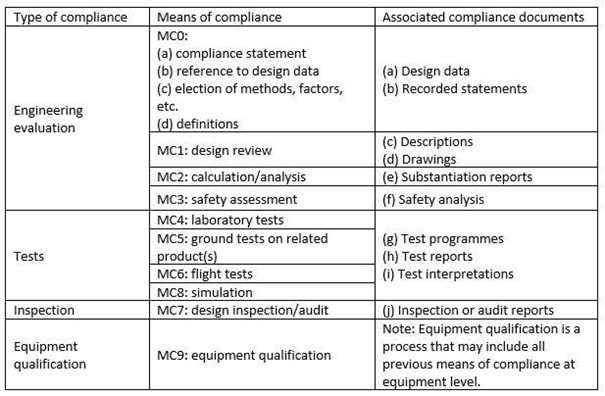
Verification of compliance with the above requirements is planned and carried out in accordance with the defined Means of Compliance (MoC), taking into account the applicable EASA Level of Involvement (LOI).
Depending on the product category (e.g. complex or non-complex), the type of change (minor, major, significant), as well as the level of design criticality and degree of innovation, additional safety analyses and assessments may be required.
Verification is based on comprehensive design qualification through inspections and testing.
Categorisation should be performed in accordance with Appendix A to AMC 21.A.15(b).
The following outlines a typical high-level certification process, taking into account the requirements of EASA Part 21, Subpart J (Design Management System, DMS), as well as the guidelines:
- ARP 4754 – Guidelines for the Development of Civil Aircraft and Systems
- ARP 4761 – Guidelines and Methods for Conducting the Safety Assessment Process on Civil Airborne Systems and Equipment

Abbreviations according to ARP 4761:
FHA – Functional Hazard Assessment
PASA – Preliminary Aircraft Safety Assessment
CCA – Common Case Analysis
PSSA – Preliminary System Safety Assessment
1.3 Issuance of the Certificate – Prerequisites and Conditions
- Demonstration of compliance with certification requirements has been successfully completed
- The function of the aircraft or the implemented change, as well as system functions, meet all applicable requirements
- Qualification of parts and systems through inspections and testing has been completed
- Flight testing has been successfully conducted and completed
- Design data are complete and available
- Operating documentation (e.g. Aircraft Maintenance Manual – AMM, Aircraft Flight Manual – AFM) has been prepared and is available
2. ACC Services in the Area of Product Certification and Product Changes
We provide comprehensive support to our clients in the development and certification of aircraft, systems, and components—from the concept phase through to serial production. Our service portfolio includes the following key areas:
Concept and development phase
- Preparation and evaluation of concept designs
- Development of Product Development Plans, including a Statement of Work—covering development, certification, and production through to after-sales support, based on ARP 4754A, APQP, and other relevant standards
- Development of certification programmes taking into account all certification requirements (e.g. certification specifications, environmental protection requirements: Certification basis, test planning, prototyping, Design Verification, For aircraft, systems and parts
Development and implementation of design safety concepts to identify design weaknesses and failure points related to system and component functions
- Applying appropriate risk mitigation measures to minimise design risks in line with the methodologies defined in ARP 4761
- Assessment of non-safety-related parts in accordance with 21.A.307(b)(3)
- Qualification of parts, including ETSO and COTS components
Compliance demonstration and development of test plans for parts and components
- Performing extensive prototyping activities
Organisation of prototype part manufacturing
- Ensuring conformity of test articles (e.g. test specimens) in accordance with relevant requirements
- Preparing the transition from prototype manufacturing to serial production
- Performing re-certification activities—from prototype to the new serial version